Ask any working nurse what prepared them best for the ward, and few will point to a textbook. They'll point to the first time they practiced starting an IV line, taking vitals, or repositioning a patient — and how much less frightening the real thing felt because of it.
At Smt. S.G. Rao Nursing College, that principle shapes how the programme is structured. Classroom instruction in anatomy, physiology, and patient care theory runs alongside regular sessions in a dedicated skills laboratory, so that by the time students move into clinical postings, they've already rehearsed the procedures they'll be asked to perform.
What the skills lab actually looks like
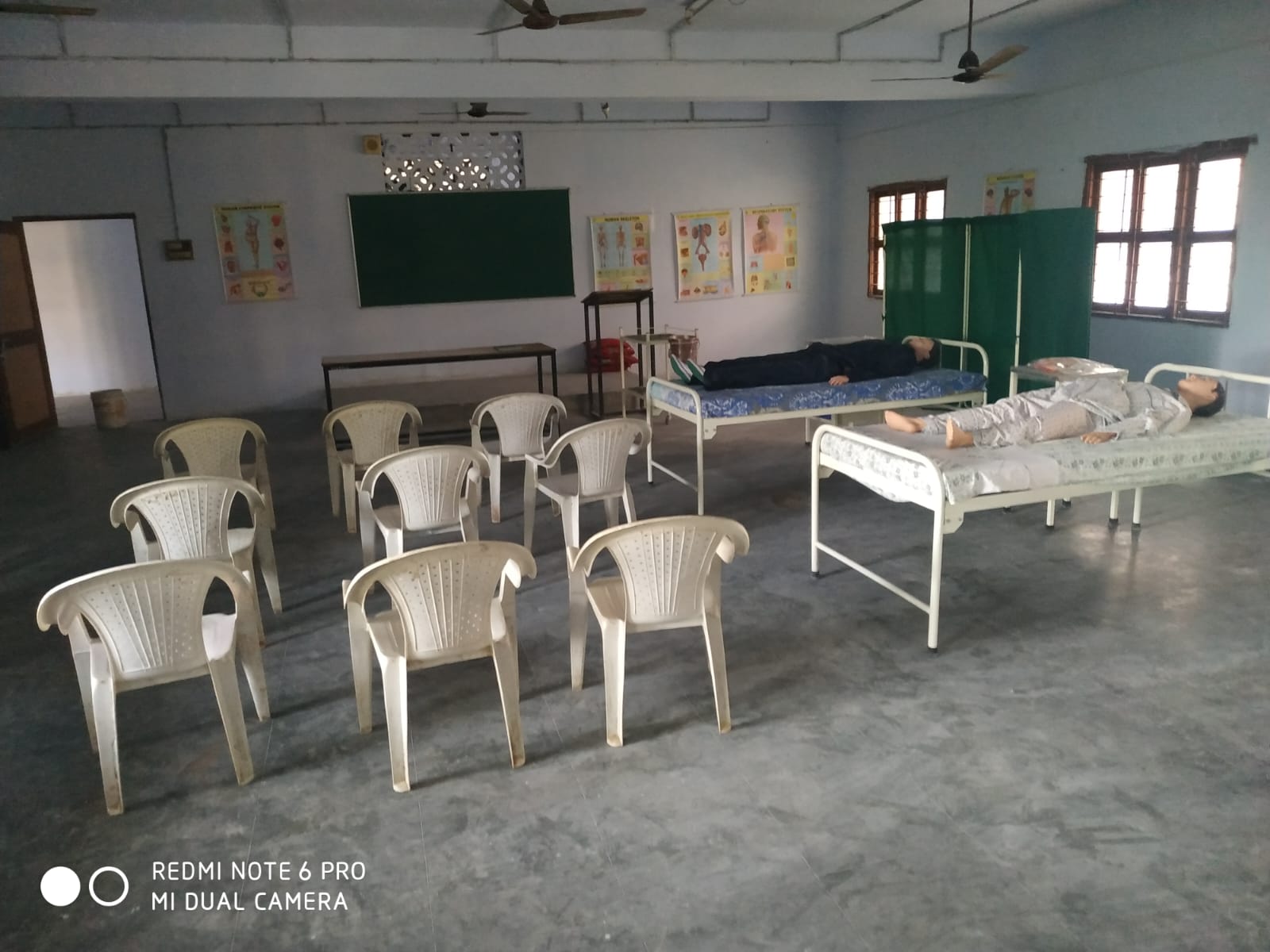
The laboratory is equipped with training beds, patient simulation manikins, and anatomy charts. Students work in small groups, walking through procedures step by step under faculty supervision — checking vitals, practicing injections, and learning correct patient-handling technique on the manikins rather than on each other or, worse, on a patient for the first time.
That's not just a comforting idea — it's a safety principle. Clinical errors are far more likely when a technique is genuinely new to the person performing it. Rehearsal in a controlled environment, where a mistake costs nothing but a redo, builds the kind of muscle memory that keeps both students and future patients safer.
A pledge before the ward
Before nursing students move from the lab into supervised clinical practice, they take part in a formal lamp-lighting ceremony — a tradition observed at nursing colleges that marks a student's commitment to the profession. It's a small ritual, but it draws a clear line: classroom and lab work are preparation; what follows is real responsibility for real patients.
Why this matters if you're choosing a nursing programme
When evaluating any nursing college, it's worth asking a direct question: how much hands-on lab time is actually built into the schedule, and what equipment is available for practice? A strong lecture syllabus matters, but clinical competence is built through repetition — and repetition needs the right facility.
- Ask whether the skills lab is available for practice outside scheduled class hours.
- Ask how students are assessed on practical skills, not just written exams.
- Ask how the transition from lab to clinical posting is supervised.
Nursing is, at its core, a hands-on profession learned by doing. A college that treats its skills laboratory as central to the curriculum — not an occasional add-on — is one that takes that seriously.